If you’ve ever ordered a bottle of pure drinking water from a convenience store, or used a point-of-use reverse osmosis (RO) system at home, odds are you didn’t think about the unassuming, cylindrical part that makes all that clean water possible: the commercial RO membrane housing. As a supplier of commercial RO systems for over a decade, I’ve seen customers gloss over this component time and again, focusing on membrane brand, permeate flow rates, or pre-treatment steps, only to run into avoidable issues. The housing isn’t just a protective sleeve for the RO membrane—it’s the unsung backbone of the entire RO process, and understanding its function is the difference between a system that runs reliably for 5+ years and one that breaks down, wastes water, and costs you thousands in repairs. Commercial RO System
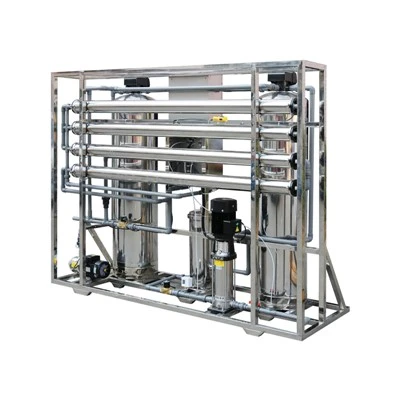
Let’s start with the basics: commercial RO membrane housings are engineered to hold one or more spiral-wound RO membranes in a pressure vessel, designed to withstand the extreme force of high-pressure feed water. But their core functions go far beyond just holding parts in place. First, they create a sealed, pressure-tight environment for the RO process itself. Spiral-wound RO membranes work by forcing pressurized water (usually 80–150 psi for standard commercial systems) through a semi-permeable membrane, which traps contaminants like dissolved salts, heavy metals, bacteria, and microplastics while allowing clean water (permeate) to pass through. If the housing isn’t properly sealed, that high pressure will cause feed water to leak out before it even reaches the membrane, or worse, push unfiltered feed water straight into the permeate line—ruining your product water quality and wasting water in the concentrate stream. I’ve had customers come to me after installing a cheap, off-brand housing from a local hardware store, only to find 15–20% of their feed water leaking before the membrane, cutting their overall system efficiency by nearly half. That’s not a small inefficiency for a café, bottling plant, or manufacturing facility that uses thousands of gallons of water daily.
Next, commercial RO membrane housings create the precise flow path that maximizes membrane performance. Every membrane inside a housing has a feed side, a permeate side, and a concentrate side that flushes away trapped contaminants. The housing’s internal design—including spacers, baffles, and end caps—guides the feed water across the membrane surface at a consistent, turbulent flow rate, which prevents “concentration polarization.” That’s a fancy term for when contaminants build up on the membrane surface faster than they can be flushed away, creating a layer of “crud” that slows permeate production and shortens membrane life. A poorly designed housing will create dead spots where flow is too slow, leading to concentration polarization, scaling, and membrane fouling just 6–12 months after installation. I recently worked with a small food processing facility that replaced their 3-year-old membranes early because their generic housing didn’t maintain the required cross-flow velocity; by switching to a precision-engineered housing, they extended membrane life to 5 years and cut their membrane replacement costs by 40% annually.
Another critical function of the commercial RO membrane housing is protecting the membrane from physical and environmental damage. RO membranes are delicate, thin polymer films wrapped around a central permeate tube—they can tear, puncture, or degrade if exposed to rough handling, extreme temperatures, or pressure surges. A high-quality housing is made from materials like fiberglass-reinforced plastic (FRP) or food-grade stainless steel, both of which resist corrosion, UV damage (for outdoor installations), and the high pressure that’s essential for RO operation. For food and beverage facilities or pharmaceutical plants, where water purity is non-negotiable, the housing’s material also prevents leaching of chemicals or contaminants into the water stream. Cheap, non-FRP housings can warp under prolonged pressure, creating gaps around the membrane that let contaminants pass through, or leach BPA or other chemicals into the permeate water. We’ve had clients in the bottled water industry reject product batches because of off-flavors traced back to a low-grade housing—costing them hundreds of thousands in wasted product and brand damage.
Commercial RO membrane housings also play a key role in system flexibility and scalability. A lot of people don’t realize that housings are modular: a single 2.5-inch diameter housing can hold one 2.5-inch membrane, while a 4-inch diameter housing can hold one or more 4-inch membranes, depending on the system’s required capacity. Modular housings let you build a system to match your exact needs, whether you’re a small café needing 50 gallons per day (GPD) or a large manufacturing facility needing 50,000 GPD. They also make maintenance far easier: instead of shutting down the entire system to replace a membrane, you can simply remove the housing end cap, swap out the membrane, and be back up and running in 15–20 minutes. We train all our clients on this, but I’ve seen customers who bought non-modular, custom housings struggle with every membrane replacement, leading to longer downtime and lost revenue.
Wait, but what about the “commercial” part of the housing? Why does a residential RO housing not work for commercial applications? Residential systems are low-pressure, low-volume, and often use small 1.8-inch membranes housed in lightweight plastic sleeves that can’t handle the constant high flow and pressure of commercial use. Commercial housings are designed for continuous operation—24 hours a day, 7 days a week, for months on end—without warping, leaking, or failing. They also meet strict industry standards: NSF/ANSI 58 for food and beverage applications, NSF/ANSI 61 for potable water, and pressure ratings that match commercial RO system requirements (usually up to 300 psi, compared to 100 psi for residential). A residential housing might work for a small side project, but it will fail quickly in a commercial setting, leading to costly disruptions.
I can’t stress enough how often customers overlook the housing when designing their RO system. At our company, we don’t just sell membranes and filters—we work with clients to match every component, including the housing, to their specific needs. For example, a bottling plant that uses high-salinity feed water (like well water) needs a housing with reinforced baffles to handle higher cross-flow velocity and reduce scaling. A pharmaceutical plant needs a 316 stainless steel housing that can be sanitized with high-temperature steam without corroding. A café that uses municipal water might get by with a FRP housing with standard seals, but still benefits from a precision flow path that cuts water waste.
We’ve seen clients who tried to save money by buying cheap housings end up paying more in the long run. A $50 off-brand housing might seem like a deal, but if it leaks, damages the membrane, or causes premature fouling, you could end up replacing a $150 membrane every year instead of every 5, plus paying for wasted water and downtime. In one case, a car wash facility we worked with saved $200 on a set of housings, but within 8 months, three housings had warped, leading to a 30% drop in permeate production, costing them over $1,200 in lost revenue and $500 in emergency repairs. Switching to our commercial-grade FRP housings fixed the problem, and they haven’t had an issue in 3 years.

So, the next time you’re designing or maintaining a commercial RO system, don’t treat the membrane housing as an afterthought. It’s not just a pipe to hold your membrane—it’s a critical component that ensures your system runs efficiently, produces consistent high-quality water, and lasts for years. If you’re not sure which housing is right for your system, or you’re looking to upgrade your current housing to boost performance and reduce costs, don’t hesitate to reach out. We’re here to help you every step of the way, from system design to ongoing maintenance, so you can focus on your business, not your water treatment.
Large Capacity EDI Module For more information on commercial RO membrane housing specifications, industry standards, and best practices for system design, please refer to the following sources:
- Water Quality Association. Reverse Osmosis Systems: Design, Installation, and Maintenance. WQA International, 2021.
- American National Standards Institute/National Sanitation Foundation. NSF/ANSI Standard 58: Reverse Osmosis Drinking Water Treatment Systems. NSF International, 2020.
- Meltzer, Theodore. Water Purification in Pharmaceutical Manufacturing. CRC Press, 2019.
- Kreke, John. Industrial Reverse Osmosis: Principles and Applications. McGraw-Hill, 2018.
- Commercial Water Supply Association. Guide to Commercial RO System Components. CWSA, 2022.
Huamo Group
Fujian Huamo Technology Co., Ltd. is one of the most professional commercial ro system manufacturers and suppliers in China, featured by quality products and good service. Please rest assured to wholesale the best commercial ro system made in China here and get price list from our factory. Contact us for custom service and OEM service.
Address: No.6 Hengtong Rd, Shanmei Village, Xiamei Town, Nanan City, Fujian Province, China
E-mail: info@huaromembrane.com
WebSite: https://www.hmromembrane.com/
